Abstract
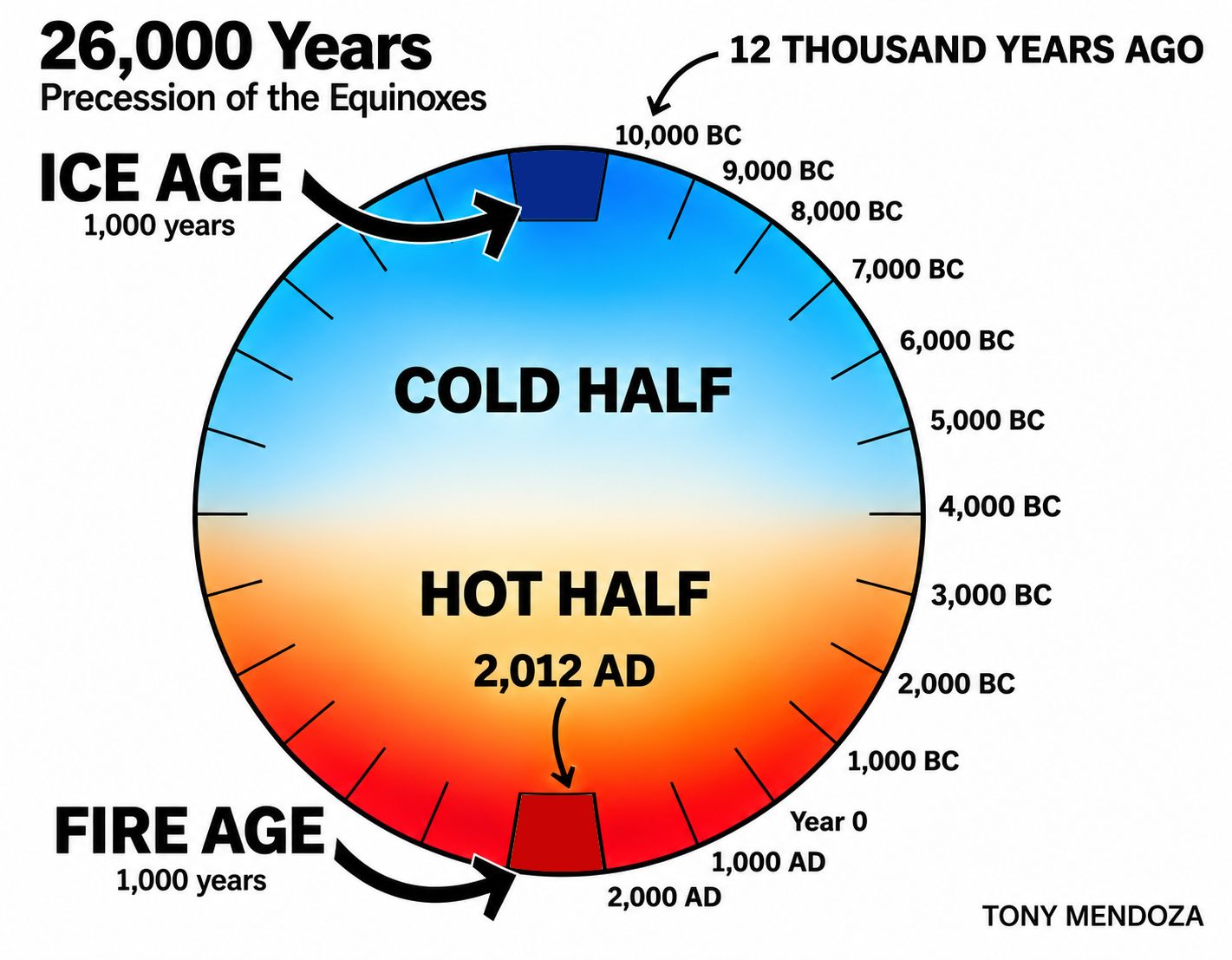
Tony Mendoza proposes that Earth's long-term climate may be connected to an enormous astronomical cycle known as the precession of the equinoxes. The stars above our head spin everyday, but as they do they shift a tiny bit. For the stars to shift and return to their original location takes 26,000 years. This theory proposes that this great cycle can be divided into two major climatic phases: a cold half and a hot half. At the extreme end of each half, the theory proposes a 1,000-year period of climatic extremes. The cold extreme produces an Ice Age, while the opposite extreme produces what this theory calls a Fire Age.
According to Mendoza, humanity has been moving away from the cold extreme of the previous Ice Age and gradually toward the opposite extreme. The theory identifies December 21, 2012, as the beginning of the Fire Age. Rather than representing an apocalypse, the date is interpreted as the beginning of a new climatic phase. Mendoza predicts that the next several centuries will bring progressively warmer and more unstable conditions, eventually reaching an extreme climatic maximum accompanied by massive flooding and profound changes to human civilization. Following this hypothetical peak, the Earth would gradually cool, beginning another long journey toward the next Ice Age.
Introduction
There is no question that Earth's climate has changed dramatically throughout its history. We know from geological evidence that glaciers have advanced and retreated, sea levels have risen and fallen, temperatures have warmed up and entire ecosystems have appeared and disappeared.
Mendoza proposes that Earth is connected to a giant astronomical clock, a cycle that takes approximately 26,000 years to complete. That clock is the precession of the equinoxes. And if we divide this enormous cycle into a cold half and a hot half, a very different picture of Earth's climate history begins to emerge.
According to Mendoza, the Earth moves through 13 thousand of years of transition before eventually reaching one of two climatic extremes. At one extreme is the Ice Age, representing the coldest portion of the cycle. At the opposite extreme is the Fire Age, representing the hottest portion. Each extreme is proposed to last approximately 1,000 years, while the rest of the 26,000-year cycle consists of the long transition between them.
This is the idea behind the Fire Age Theory.
The 26,000-Year Astronomical Clock
Mendoza treats this precessional cycle as a kind of astronomical clock. Imagine taking the entire 26,000-year cycle and placing it around the face of a giant clock. At one point, the clock reaches one extreme. Then it begins moving through the cycle. Thousands of years pass as it travels toward the opposite side, where it reaches another extreme before eventually continuing around again.
Mendoza proposes that these two sides correspond to two broad climatic phases. One half of the cycle represents a cold phase, while the other half represents a hot phase. The important point is that the Ice Age and Fire Age themselves do not occupy half of the cycle. Instead, they represent the extreme ends of their respective halves.
In this model, the Earth spends thousands of years transitioning between climatic extremes before eventually reaching a relatively short period of approximately 1,000 years at the extreme end of the cycle.
The End of the Last Ice Age
To understand where we are supposedly going, we first need to look at where we came from.
Approximately 12,000 years ago, Earth was emerging from the last Ice Age. Massive glaciers covered enormous areas of the earth, and the climate was dramatically different from the one experienced by modern civilization. As global temperatures increased, these enormous ice sheets began to retreat.
The consequences were enormous.
Ice melted and flowed into the oceans. Rivers changed. Lakes expanded. Ecosystems shifted. Animals migrated into newly available environments, while other species disappeared. Human populations were forced to adapt to rapidly changing landscapes and resources. Perhaps most importantly, sea levels began rising as enormous quantities of water that had been locked away in glaciers returned to the oceans.
The world was transforming.
Agriculture became possible in many regions. Permanent settlements appeared. Villages grew into cities, and cities eventually became civilizations and empires.
From the perspective of the Fire Age Theory, however, this was not simply the end of an Ice Age. It was the beginning of a much larger journey.
The Earth had reached the cold extreme of the great cycle, and the clock had begun moving away from that extreme.
The glaciers were retreating, the planet was warming, and humanity was entering a new chapter.
But if the cycle continued, then eventually the Earth would have to reach the opposite side.
The hot extreme.
The Long Journey From Ice to Fire
Mendoza does not suggest that the Earth suddenly changes from an Ice Age into a Fire Age overnight. Instead, he proposes a gradual movement across thousands of years.
A human lifetime is simply too short to observe the entire process. Even several generations would represent only a tiny portion of the cycle. To us, climate changes may appear to be separate events occurring independently. But from the perspective of thousands of years, those same events could potentially form part of a much larger pattern.
The Earth leaves the cold extreme and gradually moves toward warmer conditions. Humanity develops during this transition, largely unaware of the enormous astronomical clock operating in the background.
Thousands of years pass.
Civilizations rise and fall. Languages change. Religions appear and disappear. Empires conquer enormous territories and eventually collapse. Technology advances from stone tools to agriculture, metalworking, writing, engines, electricity, computers, and eventually artificial intelligence.
Yet the astronomical clock continues turning.
Mendoza proposes that eventually the Earth reaches the opposite side of the cycle. The long transition ends, and the planet enters its extreme warm period.
That period is what the theory calls the Fire Age.
December 21, 2012
This brings the theory to one of the most famous dates in recent history: December 21, 2012.
For years, this date was associated with predictions of the end of the world. Popular culture transformed the date into an expected apocalypse, with movies, documentaries, books, and countless internet theories suggesting that something catastrophic was supposed to happen.
But the Maya calendar itself does not necessarily require such an interpretation.
December 21, 2012 corresponded to the completion of a major cycle in the Maya Long Count calendar. Rather than necessarily representing the destruction of the world, it can be understood as the completion of one period and the beginning of another.
This distinction is critical to the Fire Age Theory.
Instead of saying that the Maya predicted an apocalypse, Mendoza proposes that the date represents a symbolic transition between great eras. According to this interpretation, December 21, 2012 was not the day the world was supposed to end. It was the day the next phase was supposed to begin.
And this is where the Fire Age Theory makes its central connection.
The theory proposes that December 21, 2012 marked the beginning of the Fire Age.
If that interpretation is correct, then we should not expect the world to suddenly become unrecognizable in a single day. A 1,000-year climatic period would have to develop gradually. The year 2012 would therefore represent the beginning of the process rather than its conclusion.
Humanity would still be living near the very beginning of the Fire Age.
The First 500 Years
According to Mendoza, the 1,000-year Fire Age can itself be divided into two major stages. The first approximately 500 years represent the climb toward the climatic maximum, while the second 500 years represent the gradual decline away from that maximum.
This means that the period beginning in 2012 would be the beginning of the climb.
Mendoza predicts that temperatures and environmental instability would progressively increase over the coming centuries. The changes would not necessarily happen at the same speed everywhere, and they would not necessarily be obvious from one year to the next. Instead, the idea is that the overall trend would become increasingly dramatic as the centuries passed.
As conditions become more extreme, Mendoza predicts increasing drought, severe storms, flooding, famine, earthquakes, volcanic activity, and other forms of environmental instability. These events would place increasing pressure on human civilization.
The important point is that the theory connects environmental instability with social instability.
Human societies depend on relatively predictable environmental conditions. Agriculture requires reliable water and seasons. Cities require stable infrastructure. Coastal populations depend on relatively stable shorelines. Food production, transportation, trade, and political systems all depend on the environment remaining within certain limits.
If those conditions deteriorated over centuries, the consequences could extend far beyond climate itself.
Food shortages could lead to migration. Migration could create competition for resources. Competition could produce political instability. Political instability could lead to conflict. And conflict could make it even more difficult for societies to adapt to the changing environment.
In the Fire Age scenario, these problems could gradually compound until civilization itself was forced to transform.
The Great Flood
The most dramatic prediction of the Fire Age Theory concerns the eventual rise of the oceans.
At the end of the previous cold extreme, enormous quantities of ice melted and sea levels rose substantially. Mendoza proposes that the opposite extreme could produce an equally dramatic transformation, except this time the planet would be dominated by heat rather than ice.
As the Earth approaches the peak of the Fire Age, the theory predicts that enough ice could disappear to cause enormous changes in the world's coastlines.
The maps we use today could become obsolete.
Cities that currently sit along coastlines could eventually be underwater. Low-lying regions could disappear beneath rising seas. Populations would be forced to move toward higher ground, and entire regions that currently support millions of people could become uninhabitable.
Human civilization would be concentrated in increasingly limited areas.
Mountains and elevated regions could become some of the most valuable real estate on the planet, while enormous portions of today's coastal world could disappear beneath the ocean.
The Earth would look radically different from the world we know today.
This would represent the maximum point of the Fire Age—the moment when the great astronomical clock reaches the hottest extreme of its cycle.
But according to the theory, this would not be the end of the story.
It would be the midpoint.
The Turning Point
After approximately 500 years of rising toward the climatic maximum, Mendoza proposes that the cycle would begin to reverse.
The Earth would start cooling.
The same enormous clock that carried the planet toward the hot extreme would continue turning, eventually moving away from it. The climate would gradually change again, and the extreme conditions would begin to decline.
The flood waters would slowly recede.
Temperatures would begin falling.
Some regions that had become too hot or too unstable for human habitation could once again become livable. Survivors would begin rebuilding societies in a world that looked nothing like the one their ancestors had known.
If humanity survived such a transformation, the survivors would not simply inherit the ruins of the old world. They would inherit an entirely different planet.
The locations of coastlines would have changed. Former cities could lie beneath the ocean. New inland settlements would emerge. Cultures would develop around the new geography, and eventually the events of the Fire Age would become ancient history.
Over the following thousands of years, the Earth would continue cooling.
The clock would continue turning.
And eventually, the planet would begin approaching the opposite extreme once again.
Returning to Ice
Mendoza ultimately describes a circular process.
The Earth moves away from the cold extreme, passes through thousands of years of transition, reaches the hot extreme, and then begins the long journey back toward cold conditions.
In this model, the Fire Age is not the final chapter.
It is simply one half of a much larger cycle.
After the Fire Age ends, the planet would continue cooling for thousands of years. Eventually, approximately 12,000 years after the beginning of the Fire Age, the Earth would once again approach the cold side of the great cycle.
Another major Ice Age would occur.
Once again, glaciers would expand.
Once again, sea levels would fall as enormous quantities of water became locked in ice.
Once again, ecosystems would transform.
And once again, humanity—if it survived and remained recognizable—would have to adapt to a radically different planet.
The cycle would continue.
Ice would eventually give way to warming.
Warming would eventually lead toward Fire.
Fire would eventually give way to cooling.
And cooling would eventually return to Ice.
The astronomical clock would complete another revolution.
Conclusion
Mendoza's Fire Age Theory is ultimately an attempt to look at Earth's climate from a much larger perspective.
Human beings naturally think in relatively short periods of time. We think about years, decades, and occasionally centuries. Governments are elected for a few years at a time. Businesses plan around financial quarters and annual budgets. Even the history of entire civilizations can seem enormous when compared with a human lifetime.
But Earth operates on a different clock.
Geological and astronomical processes can take thousands or millions of years to unfold. A 26,000-year cycle is so long that an entire civilization can rise and disappear without experiencing even a small portion of it.
That is what makes the idea of a great climatic cycle so intriguing.
Perhaps the climate changes we observe today are simply part of a much larger process that cannot be understood by looking at a few decades or centuries.
Perhaps the end of the last Ice Age was not merely an isolated event.
Perhaps the warming that followed represents one stage in a much larger cycle.
And perhaps humanity has now approached the opposite extreme.